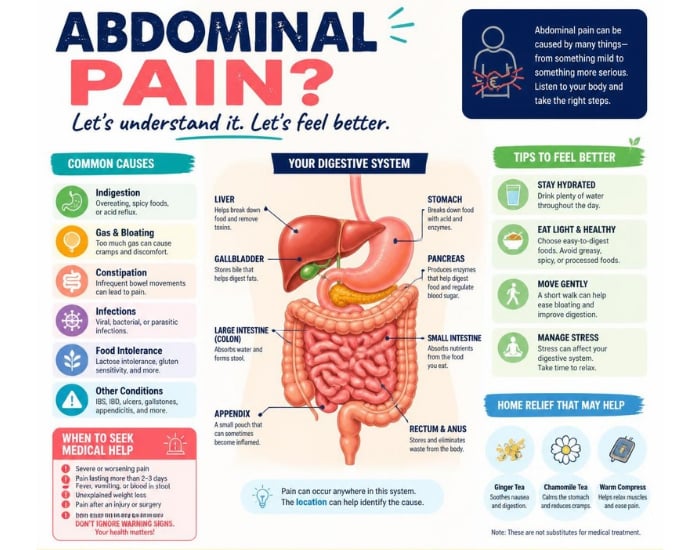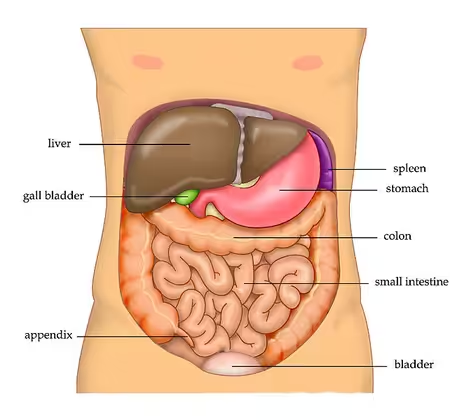
What causes pain in the abdomen above the belly button?
Pain above the belly button, in the upper middle (epigastric) area, is most often caused by indigestion, gastritis, peptic ulcers, acid reflux and overeating. Other causes include gallbladder problems, pancreatitis, early appendicitis, which often starts near the belly button before moving to the lower right, a hernia in the abdominal wall, and, importantly, a heart attack, which can feel like upper stomach pain.
| Cause | Typical clues |
|---|---|
| Indigestion or functional dyspepsia | Fullness, discomfort or burning after meals |
| Gastritis | Gnawing or burning pain, nausea, often with NSAID or alcohol use |
| Peptic ulcer | Burning pain, often on an empty stomach or at night |
| Acid reflux | Burning rising into the chest, sour taste |
| Pancreatitis | Severe pain boring through to the back, vomiting |
| Early appendicitis | Vague pain near the belly button moving to the lower right |
| Epigastric or umbilical hernia | A bulge that may hurt with lifting or coughing |
| Heart attack | Pressure with shortness of breath, sweating or nausea |
Is pain above the belly button my stomach?
Often, yes. The stomach sits in the upper middle abdomen, so burning, gnawing or full feelings above the belly button commonly come from gastritis, ulcers, indigestion or acid reflux. These are frequently linked to H. pylori infection, anti-inflammatory pain relievers, alcohol and large or fatty meals. Testing for H. pylori and, when needed, an upper endoscopy can confirm the cause.
Read why your stomach burns and about stomach inflammation symptoms.
Can pain above the belly button be appendicitis?
Yes, early on. Appendicitis often begins as a vague, dull pain around or just above the belly button that, over several hours, moves to the lower right abdomen and becomes sharp and constant, often with loss of appetite, nausea and a low fever. Pain that follows this pattern needs emergency evaluation.
How appendicitis pain often moves
- Hours 0 to 6Dull pain around or above the belly button, poor appetite.
- Hours 6 to 24Pain shifts to the lower right and becomes sharp.
- WorseningPain with walking or coughing, nausea, fever: go to the ER.
Have symptoms like these?
Dr. Muhammad Ali Khan, a board-certified gastroenterologist and hepatologist, sees adults at our Katy and Cypress offices, serving patients across Greater Houston.
When is pain above the belly button an emergency?
Get emergency care for pain above the belly button that is severe or getting worse, spreads to the back, moves to the lower right abdomen, or comes with chest pressure, shortness of breath, sweating, persistent vomiting, vomiting blood, black stools, fever, a rigid belly, or a painful hernia bulge that cannot be pushed back in.
Call 911 or go to the ER for
- Upper belly pressure with shortness of breath, sweating or nausea
- Severe pain spreading to the back
- Pain moving to the lower right with fever
- Vomiting blood or black stools
- A hard, painful hernia bulge
How can I ease mild pain above the belly button?
For mild pain that seems related to digestion, eat smaller and blander meals, avoid alcohol, spicy and fatty foods, stay upright after eating, and avoid anti-inflammatory pain relievers such as ibuprofen and naproxen. An antacid may help indigestion. If pain lasts more than a few days or keeps returning, see a doctor.
Tip: Note your pain relievers
Regular ibuprofen, naproxen or aspirin are a common cause of upper stomach pain. Tell your doctor how often you take them.
How is the cause diagnosed?
A doctor reviews your symptoms and medicines and examines your abdomen. Testing may include an ECG when the heart is a concern, blood tests including lipase and liver tests, an H. pylori test, an abdominal ultrasound, a CT scan when appendicitis or pancreatitis is suspected, and an upper endoscopy (EGD) to look for gastritis or ulcers.
See upper abdominal pain causes and abdominal pain by location.
Get answers instead of guessing
Request a visit with Dr. Muhammad Ali Khan at our Katy and Cypress offices. Most major insurance plans are accepted and self-pay options are available.
Key takeaways
- Pain above the belly button most often comes from indigestion, gastritis, ulcers or acid reflux.
- Early appendicitis can start near the belly button before moving to the lower right.
- Severe pain into the back can signal pancreatitis.
- Upper belly pressure with shortness of breath or sweating can be a heart attack.
- H. pylori testing and upper endoscopy help find stomach causes.
Frequently asked questions
What organ is above the belly button?
The stomach, the first part of the small intestine (duodenum), part of the pancreas and the transverse colon sit in this area.
Why does it hurt above my belly button after eating?
Pain after eating in this area often comes from indigestion, gastritis, a stomach ulcer or reflux. Ongoing pain should be checked.
Can a hernia cause pain above the belly button?
Yes. An epigastric or umbilical hernia can cause pain or a bulge. A hard, painful bulge that cannot be pushed back needs urgent care.
Is pain above the belly button serious?
Usually it is digestive and treatable, but severe pain, pain into the back, or pain with chest symptoms needs emergency evaluation.
Do I need a referral to see a gastroenterologist in Katy or Cypress?
It depends on your insurance plan. Many PPO plans let you book a specialist directly, while some HMO plans require a referral from your primary care doctor. Call (346) 340-4414 and the team can help you check.
Sources
- NIDDK — Indigestion (dyspepsia)
- NIDDK — Gastritis and gastropathy
- NIDDK — Peptic ulcers
- MedlinePlus — Abdominal pain
- American College of Gastroenterology — Dyspepsia
Where to be seen in Katy and Cypress
United Gastroenterology Associates has two offices: Katy, at 23920 Katy Freeway, Suite 555, next to Memorial Hermann Katy Hospital, and Cypress, at 21216 Northwest Freeway, Suite 640, on US-290. Both are open Monday through Friday, 8:30 AM to 5:00 PM, closed for lunch from 12:00 to 1:30 PM, and serve patients from Fulshear, Richmond and across Greater Houston. Call (346) 340-4414 for either office.
Katy office
23920 Katy Freeway, Suite 555
Katy, TX 77494
Memorial Hermann Medical Plaza 1
Next steps
If you are dealing with pain in abdomen above belly button or any ongoing digestive concern, a focused evaluation can find the cause and start the right treatment. Dr. Muhammad Ali Khan and the team at United Gastroenterology Associates see adults from Katy, Cypress, Fulshear, Richmond, Greater Houston and across Texas. Call (346) 340-4414 or request an appointment today.
If you have severe pain, vomit blood, pass black stools or have chest pain, call 911 or go to the nearest emergency room.