Why does my stomach burn?
Your stomach burns when acid and digestive enzymes reach tissue that is not protected well enough to handle them. Normally a layer of mucus, bicarbonate and healthy blood flow shields the stomach wall. When that shield is weakened by inflammation, an ulcer, H. pylori bacteria or medicines such as NSAIDs, or when acid flows up into the esophagus, nerves in the area send a burning or gnawing signal that you feel in the upper middle of the abdomen.
Burning stomach pain is one of the most common reasons adults see a gastroenterologist, and in most people the cause is treatable. The key is that “burning” is a symptom, not a diagnosis. The same feeling can come from very different problems, and each one is treated differently. A burning stomach that settles after a heavy meal is very different from a burning that wakes you at 2 a.m. or comes with black stools.
Where you feel it, when it happens and what makes it better or worse are the clues that point toward the cause. That is why the first step at a GI visit is a careful history rather than an immediate test.
Where burning stomach pain usually comes from
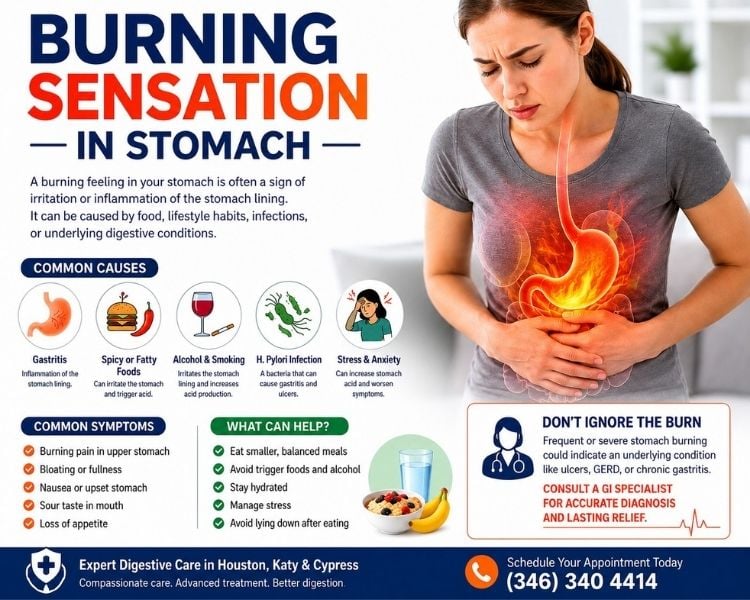
- A damaged stomach liningGastritis, peptic ulcers, H. pylori infection and NSAID pain relievers weaken the protective layer, so normal acid irritates the stomach wall.
- Acid in the wrong placeWith acid reflux (GERD), stomach contents move up into the esophagus, causing burning under the breastbone and often in the upper stomach.
- Over-sensitive nervesIn functional dyspepsia, the lining looks normal, but the stomach’s nerves overreact to normal stretching and acid levels.
Why does my stomach feel hot on the inside?
Your stomach feels hot on the inside because the nerves in the stomach and esophagus cannot tell the difference between true heat and chemical irritation. When acid irritates inflamed or exposed tissue, the brain reads that signal as warmth or burning. The temperature inside your stomach has not changed; the feeling comes from irritated nerve endings, most often due to gastritis, an ulcer, acid reflux or sensitive stomach nerves.
Patients describe it in many ways: a “hot coal” under the ribs, warmth spreading up from the stomach, a raw or acidic feeling, or heat that comes in waves after eating. Some people notice the stomach feels hot inside without any fever at all, which is expected, because the feeling is caused by irritation rather than by body temperature.
If your stomach feels hot inside now and then after a large or spicy meal and the feeling fades within a few hours, the cause is often simple irritation or reflux. If it happens most days, keeps coming back for more than two weeks, or needs antacids to keep it under control, it is worth having a digestive disease specialist look for the underlying cause.
What are the main causes of internal stomach heat and burning?
The six most common causes of internal stomach heat and burning are gastritis, peptic ulcer disease, Helicobacter pylori infection, gastroesophageal reflux disease (GERD), stomach irritation from NSAID pain relievers, and functional dyspepsia. Less common causes include bile reflux, gallbladder and pancreas problems and, rarely, stomach cancer, which is why burning that persists or comes with warning signs should be evaluated.
1. Gastritis (acute or chronic)
Gastritis is inflammation of the stomach lining (the mucosa). When the lining is inflamed and weakened, ordinary digestive acid irritates the stomach wall and produces a steady, gnawing “hot coal” feeling in the upper middle abdomen. Acute gastritis can start suddenly after heavy drinking, a viral illness or a few days of pain relievers. Chronic gastritis develops over months or years, most often because of H. pylori. Nausea, early fullness and bloating are common companions.
2. Peptic ulcer disease
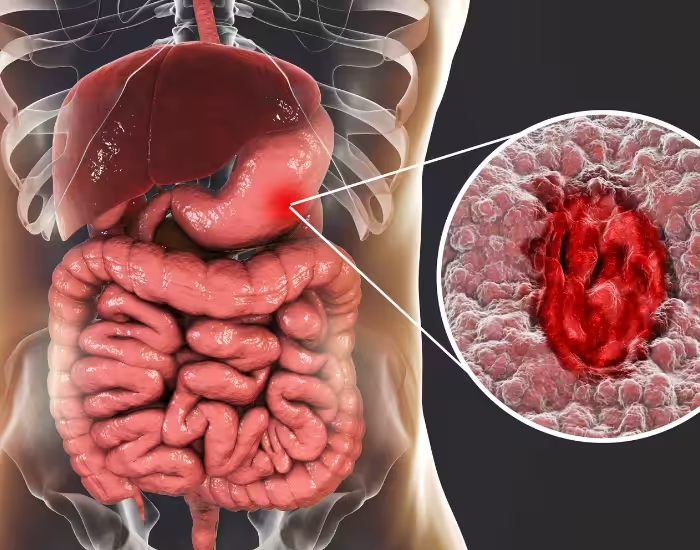
A peptic ulcer is an open sore in the lining of the stomach (gastric ulcer) or the first part of the small intestine (duodenal ulcer). The pain often flares between meals or overnight, when acid touches the raw tissue with no food to buffer it. Ulcers can bleed, so burning stomach pain with black stools, vomiting or dizziness needs urgent care.
3. Helicobacter pylori (H. pylori) infection
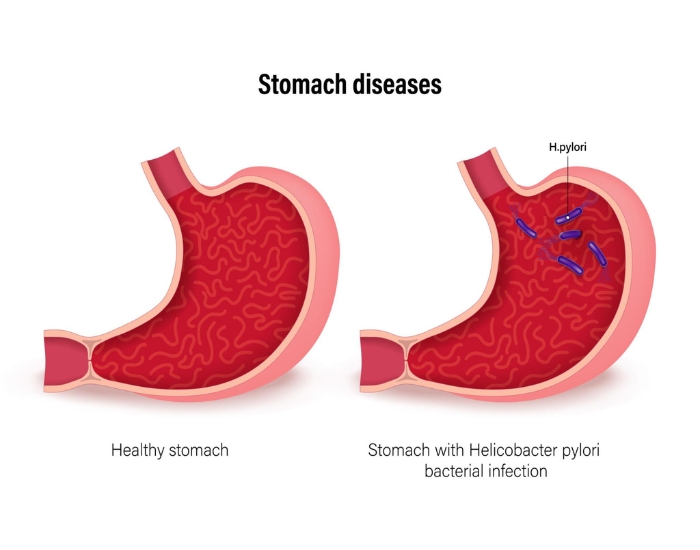
H. pylori is a bacterium that lives in the stomach’s mucus layer. It survives the acid by producing an enzyme that neutralizes the acid immediately around it, and over time it breaks down the stomach’s defenses and drives chronic inflammation and burning. H. pylori is one of the leading causes of both gastritis and peptic ulcers, and it is diagnosed with a breath test, stool test or biopsy and treated with a combination of medicines.
4. Gastroesophageal reflux disease (GERD) and acid reflux
Reflux is mostly felt in the chest as heartburn, but the burning often starts as intense warmth just below the breastbone, at the top of the stomach. Other clues include a sour taste, regurgitation, a cough or hoarseness and symptoms that worsen when lying down or bending over. Learn more about GERD diagnosis and treatment.
5. NSAID-induced gastropathy
Frequent use of common pain relievers such as ibuprofen, naproxen and aspirin blocks prostaglandins, the natural chemicals that keep the stomach’s protective mucus layer and blood flow working. Without them, the lining becomes easier to injure, and gastric burning pain, erosions and ulcers can follow. The risk is higher in adults over 60, with higher doses or long-term use, and when NSAIDs are combined with blood thinners or steroids.
6. Functional dyspepsia and visceral hypersensitivity
Some people have real, recurring burning stomach pain, yet an upper endoscopy shows no ulcer or inflammation. This is called functional dyspepsia. The nerve pathways between the gut and the brain are extra sensitive, so normal stretching after meals or normal acid levels are felt as burning, fullness or pain. It is common, it is not “in your head,” and it is treatable once other causes are ruled out.
| Cause | How the burning often feels | Common clues |
|---|---|---|
| Gastritis | Steady, gnawing burn in the upper middle abdomen | Nausea, early fullness, recent alcohol or NSAID use |
| Peptic ulcer | Burning between meals or at night | Pain that may ease or worsen with food; black stools if bleeding |
| H. pylori | Recurring burning that keeps coming back | Family history of ulcers; often found with gastritis or ulcers |
| GERD / acid reflux | Heat rising from the upper stomach into the chest | Sour taste, regurgitation, worse lying down |
| NSAID gastropathy | Burning that started after regular pain reliever use | Ibuprofen, naproxen or aspirin several times a week |
| Functional dyspepsia | Burning or fullness after normal-sized meals | Normal endoscopy; symptoms for months; stress can worsen it |
What is the difference between stomach burning from gastritis and from an ulcer?
Gastritis is widespread inflammation of the stomach lining, while an ulcer is a deeper, open sore in one spot. Gastritis tends to cause a more constant, diffuse burning with nausea and fullness. Ulcer pain is often more focused, flares between meals or at night, and carries a higher risk of bleeding. The two often occur together and share the same causes, so only an evaluation, sometimes with upper endoscopy, can tell them apart with confidence.
The timing of the pain gives a hint. Duodenal ulcer pain classically appears two to three hours after eating or wakes people at night and may ease briefly with food. Gastric ulcer pain may get worse soon after meals. These patterns overlap a great deal, though, and many people with ulcers have only mild symptoms. Because both conditions can lead to bleeding when left untreated, persistent gastric burning pain deserves a proper diagnosis rather than months of guessing.
Burning that keeps coming back?
Dr. Muhammad Ali Khan, a board-certified gastroenterologist and hepatologist, evaluates burning stomach pain at our Katy and Cypress offices, serving patients from across Greater Houston.
Why does my stomach feel hot inside after eating?
A hot or burning feeling after eating usually happens because food stretches the stomach and triggers acid release. If the lining is inflamed, the lower esophageal valve is loose, or the stomach nerves are oversensitive, that normal response is felt as heat or burning. Large, fatty, spicy or acidic meals, alcohol, coffee and eating close to bedtime make it more likely.
Burning that starts within an hour of eating points most often to gastritis, reflux or functional dyspepsia. Keeping a short food and symptom diary for two weeks helps you and your doctor see whether a specific food, portion size or meal timing is the trigger. Our guide to stomach pain after eating covers other after-meal causes, including gallbladder pain.
Why does my upper stomach burn when it’s empty or in the middle of the night?
Burning in the upper stomach on an empty stomach, or burning that wakes you between midnight and 3 a.m., is a classic pattern of a duodenal ulcer. At those times acid is still being produced, but there is no food to buffer it, so it reaches the raw ulcer directly. Night-time reflux and gastritis can cause a similar pattern, and the burning often eases briefly after eating or taking an antacid.
Night-time burning stomach pain is a symptom to take seriously, especially if you also take NSAIDs or have been told you have H. pylori. Raising the head of the bed, avoiding food for two to three hours before lying down and limiting alcohol can help reflux at night, but they will not heal an ulcer. Testing for H. pylori and, when appropriate, an upper endoscopy (EGD) can confirm the cause.
Can ibuprofen cause burning stomach pain, and what should I do?
Yes. Ibuprofen, naproxen, aspirin and other NSAIDs are among the most common causes of burning stomach pain, because they reduce the prostaglandins that protect the stomach lining. If a pain reliever is upsetting your stomach, call your doctor before taking more. Do not stop a daily aspirin or any prescribed medicine on your own, because some are taken to protect the heart; your doctor can decide whether to change the medicine or add stomach protection.
Tell the gastroenterologist about every pain reliever you use, including over-the-counter cold medicines and combination products that contain an NSAID. Seek urgent care if burning comes with black stools or vomiting, which can signal a bleeding ulcer. For many patients, switching pain relief options, treating H. pylori if present and a course of acid-reducing medicine allow the lining to heal.
When is burning stomach pain an emergency, and when is it acid reflux?
Typical acid reflux causes burning that rises into the chest after meals or when lying down and improves with antacids. Burning stomach pain is an emergency when it comes with vomiting blood, black or bloody stools, sudden severe pain, fainting, or chest pressure with shortness of breath or sweating. In those cases, call 911 or go to the nearest emergency room instead of waiting for a clinic appointment.
Red-flag symptoms that need prompt medical evaluation
Seek urgent care if the burning is accompanied by any of the following:
- Vomiting blood or material that looks like coffee grounds
- Black, tarry or maroon stools
- Unexplained weight loss or early satiety (feeling full after a few bites)
- Severe pain that spreads to the back or shoulder
- Difficulty or pain when swallowing (dysphagia or odynophagia)
- Chest pressure, shortness of breath, sweating or pain spreading to the arm or jaw, which can be a heart attack
Upper abdominal burning can occasionally be a sign of a heart problem, especially in people with diabetes, high blood pressure or a smoking history. If you are unsure whether pain is from your stomach or your heart, treat it as an emergency. For non-urgent but worrying symptoms, read when stomach pain is serious.
What doctor should I see for constant burning in my upper stomach?
See a gastroenterologist, a doctor who specializes in the esophagus, stomach, intestines, liver and pancreas, if upper stomach burning lasts more than two weeks, keeps returning, needs antacids most days, or comes with any warning sign. A gastroenterologist can test for H. pylori, perform an upper endoscopy when needed and build a treatment plan for the specific cause. Your primary care doctor is a good first stop for mild, short-lived symptoms.
At United Gastroenterology Associates, burning stomach pain is evaluated by Dr. Muhammad Ali Khan, MD, FACP, FASGE, a board-certified gastroenterologist and hepatologist and former Associate Professor of Gastroenterology at The University of Texas MD Anderson Cancer Center. He sees patients in English, Hindi and Urdu. Adults age 60 or older with new upper stomach symptoms, and anyone with a family history of stomach cancer, should be especially prompt about scheduling.
How does a gastroenterologist find the cause of burning stomach pain?
A gastroenterologist finds the cause through a detailed history, a physical exam and targeted testing. Testing often includes an H. pylori breath or stool test and blood work to check for anemia. When symptoms are persistent, severe or come with warning signs, an upper endoscopy (EGD) lets the doctor look directly at the esophagus, stomach and duodenum and take small biopsies to confirm gastritis, ulcers or infection.
Your evaluation, step by step
- Before your visitNote when the burning started, when it happens, what helps and what makes it worse. List every medicine and supplement, especially pain relievers.
- At the visitDr. Khan reviews your history, examines your abdomen and checks for warning signs that change how quickly testing is needed.
- TestingCommon next steps are an H. pylori breath or stool test, blood work and, when indicated, an upper endoscopy with biopsy.
- Your planTreatment is matched to the cause, with a follow-up to confirm the burning has settled and, for H. pylori, that the infection has cleared.
An upper endoscopy is usually done with sedation and takes only a short time. You will receive specific preparation instructions, including how long to avoid food beforehand. Some acid-reducing medicines can affect H. pylori test results, so tell the office what you are taking before testing.
How is gastric burning pain treated?
Treatment for gastric burning pain depends on the cause. H. pylori is treated with a combination of antibiotics and acid-reducing medicine, followed by a test to confirm it is gone. Gastritis and ulcers heal with acid suppression and by removing triggers such as NSAIDs and alcohol. GERD is managed with lifestyle changes and medicine, and functional dyspepsia often improves with acid reducers, H. pylori treatment if present, and therapies that calm sensitive stomach nerves.
Most people feel better within days to weeks once the true cause is treated. The goal is not just to quiet the burning with antacids, but to heal the lining and prevent complications such as bleeding or narrowing. Dr. Khan explains your results, the reason for each medicine and what to watch for, and adjusts the plan at follow-up if symptoms persist.
Tip: Track it for two weeks before your visit
Write down when the burning starts, how long it lasts, what you ate, which medicines you took and what helped. A two-week log turns a vague “my stomach burns” into a clear pattern, which often shortens the path to the right diagnosis.
What can I do at home while I wait for my appointment?
While you wait to be seen, eat smaller meals, avoid lying down for two to three hours after eating, and limit alcohol, smoking, coffee and foods that clearly trigger your burning. Ask your doctor or pharmacist before using pain relievers, since NSAIDs can make burning worse. Over-the-counter acid reducers can ease symptoms, but if you need them for more than two weeks, it is time to see a gastroenterologist.
- Eat smaller, slower meals and stop eating two to three hours before bed
- Raise the head of your bed if burning is worse at night
- Cut back on alcohol and stop smoking, both of which weaken the stomach lining
- Notice your personal triggers, such as spicy, fatty or acidic foods, and coffee
- Follow the label on over-the-counter medicines and do not exceed the stated length of use without medical advice
Home measures help many people with mild reflux, but they cannot clear H. pylori or heal an ulcer. If burning keeps returning, these steps are a bridge to an evaluation, not a replacement for one.
Get answers instead of guessing
Find out why your stomach burns. Request a visit with Dr. Muhammad Ali Khan in Katy or Cypress; most major insurance plans are accepted and self-pay options are available.
Where can patients in Greater Houston, Katy, Cypress, Fulshear and Richmond be seen?
United Gastroenterology Associates sees patients with burning stomach pain at two offices: Katy, at 23920 Katy Freeway, Suite 555, next to Memorial Hermann Katy Hospital, and Cypress, at 21216 Northwest Freeway, Suite 640, on US-290. Both offices are open Monday through Friday, 8:30 AM to 5:00 PM, closed for lunch from 12:00 to 1:30 PM. Call (346) 340-4414 for either office.
The Katy office on I-10 is the closer choice for many patients from Fulshear, Richmond, Sealy, Brookshire and west Houston, while the Cypress office serves Cypress, Tomball, Jersey Village and northwest Houston. Patients also travel from other parts of Texas for a second opinion on burning stomach pain that has not improved with earlier treatment. See our Katy gastroenterologist and Cypress gastroenterologist pages for parking and visit details.
Katy office
23920 Katy Freeway, Suite 555
Katy, TX 77494
Memorial Hermann Medical Plaza 1
Key takeaways
- Burning stomach pain most often comes from gastritis, peptic ulcers, H. pylori, acid reflux, NSAID pain relievers or functional dyspepsia.
- If you wonder why your stomach feels hot on the inside, the answer is irritated nerves, not a real rise in temperature.
- Burning on an empty stomach or at night suggests a duodenal ulcer and should be checked, especially if you take NSAIDs.
- Vomiting blood, black stools, severe pain, trouble swallowing or chest pressure with the burning need emergency care.
- A gastroenterologist can test for H. pylori, perform an upper endoscopy when needed and treat the cause so the lining can heal.
Frequently asked questions
Why does my stomach feel hot on the inside but I don’t have a fever?
A hot feeling inside the stomach is caused by irritated nerves, not by body temperature. Acid touching inflamed tissue, an ulcer or the lower esophagus is felt as heat or burning, so it is normal to have no fever. If the feeling happens often or lasts more than two weeks, see a doctor to find the cause.
Is gastric burning pain the same as heartburn?
Not exactly. Heartburn is burning behind the breastbone caused by acid reflux into the esophagus. Gastric burning pain is felt lower, in the upper middle abdomen, and is more often linked to gastritis, ulcers, H. pylori or functional dyspepsia. Many people have both, which is why a gastroenterologist looks at the full pattern of symptoms.
Can stress cause burning stomach pain?
Stress does not usually create an ulcer by itself, but it can make the stomach’s nerves more sensitive and worsen reflux and functional dyspepsia. Stress can also lead to habits, such as skipped meals, more coffee, alcohol or pain relievers, that irritate the lining. Ongoing burning should still be evaluated rather than blamed on stress alone.
How long can I take over-the-counter acid reducers before seeing a doctor?
Follow the package label. Over-the-counter proton pump inhibitors, for example, are labeled for a 14-day course and should not be repeated more often than every four months without a doctor’s advice. If you need acid reducers regularly to control burning, schedule an evaluation so the underlying cause can be found.
Does burning stomach pain mean I have stomach cancer?
Usually not. Most burning stomach pain is caused by gastritis, ulcers, H. pylori, reflux or functional dyspepsia. Stomach cancer is uncommon, but new symptoms after age 60, weight loss, trouble swallowing, anemia or vomiting are reasons to have an upper endoscopy promptly.
Do I need a referral to see a gastroenterologist in Katy or Cypress?
It depends on your insurance plan. Many PPO plans allow you to book a specialist directly, while some HMO plans require a referral from your primary care doctor. Call the number on your insurance card, or call our office at (346) 340-4414 and the team can help you check.
Next steps for burning stomach pain
You do not have to keep asking, “Why does my stomach burn?” A focused evaluation can identify the cause and start the right treatment, so your stomach lining can heal. Dr. Muhammad Ali Khan and the team at United Gastroenterology Associates see adults from Katy, Cypress, Fulshear, Richmond, Greater Houston and across Texas. Call (346) 340-4414 or request an appointment today.
If you have severe pain, vomit blood, pass black stools or have chest pain, call 911 or go to the nearest emergency room.
Sources
- NIDDK — Gastritis and gastropathy
- NIDDK — Symptoms and causes of peptic ulcers
- NIDDK — Indigestion (dyspepsia)
- NIDDK — Acid reflux (GER and GERD) in adults
- MedlinePlus — Helicobacter pylori infections
- MedlinePlus — Peptic ulcer
- MedlinePlus — Indigestion
- American College of Gastroenterology — Peptic ulcer disease
- American College of Gastroenterology — Dyspepsia