
Home › Digestive Health › Gut Inflammation
Gut inflammation guide · Medically reviewed
Gut Inflammation: Symptoms, Causes, Diagnosis & Treatment
“Gut inflammation” describes inflammation somewhere in the digestive tract, from the esophagus to the colon. It is not a single disease. This guide explains where inflammation can occur, what can cause it, how doctors test for it, and how treatment depends on the underlying diagnosis.
Medically reviewed by Muhammad Ali Khan, MD, FACP, FASGE
Board-certified gastroenterologist
Meet Your GI Specialist: Muhammad Ali Khan, MD, FACP, FASGE
BOARD-CERTIFIED Gastroenterologist and Hepatologist
CREDENTIALS AT A GLANCE
Board-Certified
Gastroenterology, hepatology, and internal medicine
Academic Medicine
Former Associate Professor, UT MD Anderson Cancer Center
Published Research
More than 100 peer-reviewed articles in gastroenterology
FACP and FASGE
Fellow, American College of Physicians and American Society for Gastrointestinal Endoscopy

Dr. Muhammad Ali Khan, MD, FACP, FASGE
Board-certified gastroenterologist and hepatologist, United Gastroenterology Associates
This page was medically reviewed by Muhammad Ali Khan, MD, FACP, FASGE, a board-certified gastroenterologist and hepatologist at United Gastroenterology Associates, PLLC. He evaluates and manages digestive and liver conditions, including gastritis, inflammatory bowel disease and celiac disease, and performs upper endoscopy and colonoscopy for patients from across Greater Houston at the practice’s Katy and Cypress offices.
Dr. Khan earned his medical degree at Dow Medical College, completed an internal medicine residency at the University of Toledo, and completed a gastroenterology and hepatology fellowship at the University of Tennessee Health Science Center. He served as an Assistant Professor at the University of Alabama at Birmingham and as an Associate Professor at The University of Texas MD Anderson Cancer Center.
He is board-certified in gastroenterology, hepatology, and internal medicine, is a Fellow of the American Society for Gastrointestinal Endoscopy (FASGE) and the American College of Physicians (FACP), and has authored more than 100 peer-reviewed articles. Last medically reviewed September 28, 2026.
Professional Memberships
- American Society for Gastrointestinal Endoscopy (Fellow, FASGE)
- American College of Physicians (Fellow, FACP)
Areas of Care
- Gastritis and H. pylori
- Crohn’s disease and ulcerative colitis
- Celiac disease
- Chronic diarrhea and colitis
- Upper endoscopy and colonoscopy
- Liver disease
What Is Gut Inflammation?
Gut inflammation is a broad, non-specific term, not a single medical diagnosis. It describes inflammation affecting part of the gastrointestinal (GI) tract, the connected organs that carry and digest food from the esophagus to the rectum. Inflammation can occur in different places and in many different conditions, such as gastritis, Crohn’s disease, ulcerative colitis, celiac disease or an infection.
That distinction matters. Two people who both say they have an “inflamed gut” may have completely different conditions that need different tests and treatments. A gastroenterologist therefore focuses on identifying where the inflammation is and what is causing it, rather than treating “gut inflammation” as one disease.
Many common digestive symptoms, such as bloating, gas or occasional abdominal discomfort, happen without any inflammation at all. For a broader overview of digestive symptoms and when to see a specialist, see our digestive problems guide.
Where Can Inflammation Occur in the Digestive Tract?
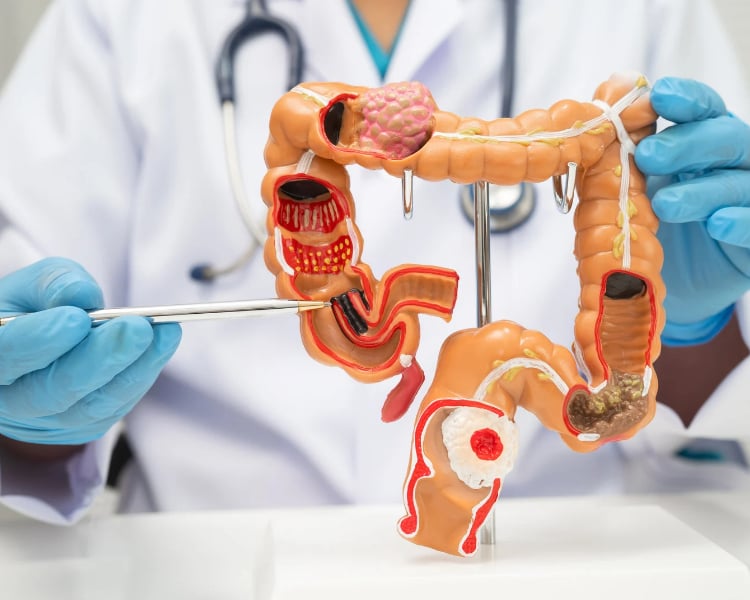
Doctors name inflammation by its location in the digestive tract. Esophagitis is inflammation of the esophagus, gastritis is inflammation of the stomach lining, enteritis is inflammation of the small intestine, and colitis is inflammation of the colon (inflammation limited to the rectum is called proctitis).
“Stomach inflammation” is therefore one specific type of gut inflammation, but gut inflammation is not always in the stomach. Some conditions affect a single area, while Crohn’s disease can involve different parts of the digestive tract, sometimes more than one at a time.
What Are Possible Symptoms of Gastrointestinal Inflammation?
Symptoms depend on where the inflammation is, how severe it is and what is causing it. Some conditions cause obvious digestive symptoms, while others, including many cases of gastritis, cause few or none. The symptoms listed here may occur with GI inflammation, but they can also occur without it.
Keep in mind: bloating, gas and abdominal discomfort are very common and frequently occur without any inflammation. On their own they do not show that the gut is inflamed, which is why persistent or concerning symptoms warrant evaluation rather than assumptions.
When to seek emergency care
Call 911 or go to the nearest emergency department for vomiting blood, heavy rectal bleeding, black or tarry stools with dizziness, severe or rapidly worsening abdominal pain, or fainting.
Symptoms that may occur
- Abdominal pain or cramping
- Persistent diarrhea
- Blood in the stool or rectal bleeding
- Urgency to have a bowel movement
- Upper abdominal burning or discomfort
- Nausea or vomiting
- Loss of appetite
- Unintentional weight loss
- Fatigue or iron-deficiency anemia
These symptoms have many possible causes. A qualified medical professional should evaluate your specific symptoms.
What Does Gut Inflammation Feel Like?
There is no single sensation that means “gut inflammation,” because it depends on where and why the inflammation is happening. Certain patterns can point toward particular areas of the digestive tract. These are general associations, not a way to diagnose yourself:
- Upper abdominal burning or discomfort may occur with gastritis, ulcers or other upper GI conditions.
- Cramping with frequent loose stools may occur with inflammatory or infectious bowel conditions.
- Urgency and blood or mucus in the stool can occur with colitis, including ulcerative colitis.
- Pain after eating, weight loss and fatigue can occur with Crohn’s disease affecting the small intestine.
Because these symptoms overlap across many conditions, a gastroenterologist uses your full history and appropriate testing, not symptoms alone, to reach a diagnosis. Learn when to see a specialist for digestive diseases.
What Can Cause Inflammation in the Digestive Tract?
Inflammation in the digestive tract has several medically recognized causes. The categories below are examples, not a complete list, and only a medical evaluation can determine the cause in an individual person.
Inflammatory Bowel Disease (IBD)
Crohn’s disease and ulcerative colitis are chronic, immune-mediated conditions that cause long-term inflammation of the digestive tract. Ulcerative colitis affects the colon and rectum; Crohn’s disease can affect any part of the GI tract and may involve the full thickness of the bowel wall.
Infections
Some bacterial, viral and parasitic infections cause short-term inflammation of the stomach or intestines, usually with diarrhea, cramping or nausea. Many settle on their own, but severe or persistent symptoms should be evaluated.
H. pylori–Associated Gastritis
Helicobacter pylori is a common bacterial infection of the stomach lining and a major cause of chronic gastritis and peptic ulcers. Many people with H. pylori have no symptoms. It is diagnosed with a breath test, stool test or biopsy.
Celiac Disease
In celiac disease, eating gluten triggers an immune response that damages the lining of the small intestine. It is not a food allergy. Testing should be done while a person is still eating gluten.
Medication-Associated Injury
Regular use of nonsteroidal anti-inflammatory drugs (NSAIDs) such as ibuprofen, naproxen or aspirin can irritate the stomach lining and cause ulcers. Some other medications can injure the esophagus or intestines. A medication review is part of every evaluation.
Other Immune-Mediated and Less Common Causes
Examples include eosinophilic esophagitis, autoimmune gastritis, microscopic colitis (seen only on biopsy), reduced blood flow to the colon (ischemic colitis) and radiation injury. These require specialist evaluation.
Gut Inflammation vs IBS vs Gastritis vs Colitis vs IBD
These terms are often mixed up online. The most important distinction is that IBS is not the same as inflammatory bowel disease (IBD). IBS is a functional, symptom-based disorder that can be uncomfortable and disruptive but does not cause the lasting inflammation and bowel damage seen in Crohn’s disease and ulcerative colitis. Because their symptoms overlap, testing is sometimes needed to tell them apart.
How Do Doctors Check for Gut Inflammation?
No single test diagnoses every cause of gut inflammation. A gastroenterologist chooses tests based on your symptoms, the suspected location and the conditions being considered. Most evaluations combine several of the following:
History and Physical Examination
Symptom pattern, duration, medications (especially NSAIDs), travel, diet, family history and warning signs guide every next step.
Blood Tests
A complete blood count (CBC) can show anemia or infection, and markers such as C-reactive protein (CRP) can suggest inflammation. Blood tests can also screen for celiac disease, but they cannot show exactly where inflammation is.
Stool Tests
Stool studies look for infection and hidden blood, and fecal calprotectin helps show whether there is inflammation in the intestines.
Endoscopy, Colonoscopy and Biopsy
An upper endoscopy examines the esophagus, stomach and duodenum; a colonoscopy examines the colon and the end of the small intestine. Biopsies taken during these procedures often confirm the diagnosis.
Imaging and Small-Bowel Tests
CT or MRI (including enterography) and, in some cases, capsule endoscopy evaluate the small intestine and complications.
The right combination depends on your situation. Many people need only some of these tests, and testing is chosen to answer a specific clinical question.
What Is Fecal Calprotectin?
Fecal calprotectin is a protein released by white blood cells called neutrophils. When the lining of the intestines is inflamed, these cells move into the bowel and calprotectin appears in the stool, where a laboratory can measure it from a small stool sample. Higher levels generally indicate more inflammation in the intestines.
Why gastroenterologists use it. For people with ongoing lower digestive symptoms such as diarrhea, fecal calprotectin can help distinguish an inflammatory condition, such as IBD, from a non-inflammatory condition, such as IBS, and help decide whether a colonoscopy is needed. The U.K. National Institute for Health and Care Excellence (NICE) recommends the test for this purpose in adults when cancer is not suspected. In people with known IBD, doctors may also use calprotectin over time, together with symptoms and endoscopy, to monitor inflammation.
Limitations. Fecal calprotectin does not diagnose a specific disease by itself. Levels can rise with gastrointestinal infections, regular NSAID use, colon polyps or colorectal cancer, diverticular disease and other conditions, and results can vary between samples and laboratories. The test mainly reflects inflammation in the intestines, so it is not a test for gastritis or reflux. A normal result makes significant intestinal inflammation less likely but does not rule out every condition.
Results need clinical interpretation. An abnormal result is a reason for discussion with your doctor, which may lead to repeat testing, other stool tests or a colonoscopy. It is not a diagnosis on its own.
How Is Gut Inflammation Treated?
There is no single universal treatment for “gut inflammation.” Treatment depends on the underlying cause, the location and severity of the inflammation, any complications, and the individual patient, which is why an accurate diagnosis comes first. General, cause-directed approaches include:
Can Diet Reduce Gut Inflammation?
It depends on the underlying condition. Diet plays a central role in some digestive conditions and a smaller role in others, and no single diet cures gut inflammation. Be cautious of claims that promise otherwise, including “detox” plans and restrictive cleanses.
- Celiac disease: gluten directly drives the immune response, so a medically supervised gluten-free diet is essential after diagnosis.
- Gastritis: according to the NIDDK, diet is not a major cause of most cases of gastritis; treating the cause, such as H. pylori or NSAID use, matters more.
- IBD: dietary needs vary from person to person and during flares, and are best managed with a gastroenterologist and, when helpful, a registered dietitian.
Probiotics, supplements and “gut cleanses” should not be assumed to treat the cause of gut inflammation. Some products interact with medications, and relying on them can delay the diagnosis of a condition such as IBD or celiac disease. Discuss any supplement with your doctor, particularly if you have ongoing symptoms.
When Digestive Symptoms Need Prompt Medical Attention
Most digestive symptoms can be evaluated at a routine appointment. Some symptoms, however, can signal a serious problem and should not wait. The lists below separate the two.
Gut Inflammation: Frequently Asked Questions
Is gut inflammation a diagnosis?
No. Gut inflammation is a description, not a specific diagnosis. A gastroenterologist works to identify the underlying condition and its location, such as gastritis, Crohn’s disease, ulcerative colitis or celiac disease.
What does an inflamed intestine feel like?
There is no single sensation. Cramping with frequent loose stools, urgency, and blood or mucus in the stool can occur with intestinal inflammation, but these symptoms also have other causes. Testing is needed to know whether inflammation is present.
Can blood tests show intestinal inflammation?
Blood tests such as a complete blood count and C-reactive protein can suggest inflammation or show anemia, and some blood tests screen for celiac disease. They cannot show the exact location or cause, so they are used alongside stool tests, endoscopy or imaging.
Does IBS cause gut inflammation?
No. IBS is a disorder of gut–brain interaction and does not cause the lasting inflammation and tissue damage seen in inflammatory bowel disease. Its symptoms can overlap with inflammatory conditions, which is why evaluation is sometimes needed.
Can stress cause gut inflammation?
Stress does not cause inflammatory bowel disease or celiac disease. It can, however, worsen digestive symptoms such as pain and changes in bowel habits, and some people with IBD notice more symptoms during stressful periods.
Can acid reflux cause inflammation?
Yes. Frequent acid reflux can inflame the lining of the esophagus, a condition called reflux esophagitis. Persistent reflux, trouble swallowing or reflux despite medication should be evaluated by a gastroenterologist.
How long does gut inflammation take to heal?
It depends on the cause. Inflammation from many infections improves within days to weeks, gastritis often improves once its cause is treated, and chronic conditions such as IBD are managed over the long term with the goal of keeping inflammation in remission.
What doctor treats gut inflammation?
A gastroenterologist. This physician specialist evaluates and treats conditions of the digestive tract and liver, including those that cause inflammation in the esophagus, stomach, intestines and colon.
Need a Gastroenterology Evaluation in the Houston Area?
United Gastroenterology Associates, PLLC evaluates digestive symptoms and inflammatory GI conditions with Muhammad Ali Khan, MD, FACP, FASGE, at offices in Katy and Cypress, Texas. Learn about our Katy gastroenterology office or Cypress gastroenterology office, or call (346) 340-4414 to request an appointment.
Sources
- National Institute of Diabetes and Digestive and Kidney Diseases (NIDDK). Gastritis & Gastropathy. niddk.nih.gov
- NIDDK. Crohn’s Disease. niddk.nih.gov
- NIDDK. Ulcerative Colitis. niddk.nih.gov
- NIDDK. Celiac Disease. niddk.nih.gov
- NIDDK. Microscopic Colitis. niddk.nih.gov
- NIDDK. Irritable Bowel Syndrome (IBS). niddk.nih.gov
- NIDDK. Peptic Ulcers (Stomach or Duodenal Ulcers). niddk.nih.gov
- National Institute for Health and Care Excellence (NICE). Faecal calprotectin diagnostic tests for inflammatory diseases of the bowel (DG11). nice.org.uk
- Lichtenstein GR, et al. ACG Clinical Guideline: Management of Crohn’s Disease in Adults. Am J Gastroenterol. 2018. pubmed.ncbi.nlm.nih.gov
- American College of Gastroenterology. Clinical Guidelines. gi.org
This page provides general educational information and does not replace medical advice, diagnosis, or treatment. Symptoms should be evaluated by a qualified medical professional. For a medical emergency, call 911. Medically reviewed by Muhammad Ali Khan, MD, FACP, FASGE. Last medically reviewed September 28, 2026. Last updated September 28, 2026.