Swallowing problems often creep up slowly. People start cutting meat into smaller pieces, drinking water with every bite, or avoiding bread and rice without really noticing. Then one day a piece of food sticks and will not go down.
That pattern — trouble with solid foods that gradually gets worse — is the classic story of an esophageal stricture. This guide explains why strictures form, how they are found and treated, and why the underlying cause matters as much as the stretching itself.
If food is stuck right now
If you cannot swallow your saliva, are drooling, or have chest pain after food became stuck, go to the nearest emergency room. A food impaction needs prompt endoscopic removal.
What Is an Esophageal Stricture?
An esophageal stricture is a narrowed segment of the esophagus, the muscular tube that carries food from the throat to the stomach. The narrowing is usually caused by scar tissue or inflammation, and it makes solid food harder to pass. Most strictures are benign and respond well to treatment, but a doctor should check every new stricture to rule out cancer.
A normal adult esophagus is roughly 2 centimeters (about 20 millimeters) wide. Symptoms usually start once the opening narrows to about 13 millimeters or less, and solid foods such as meat, bread and rice are affected first.
Doctors divide strictures into two broad types:
- Benign strictures — not cancer. These are by far the most common and include peptic strictures, rings and inflammatory strictures.
- Malignant strictures — caused by esophageal cancer or a tumor pressing from outside. These need a different treatment plan, which is one reason every new stricture should be examined and biopsied when appropriate.
Strictures are also described as simple (short, straight and easy to pass with an endoscope) or complex (long, angled or very narrow). Complex strictures often need more dilation sessions.
What Are the Symptoms of an Esophageal Stricture?
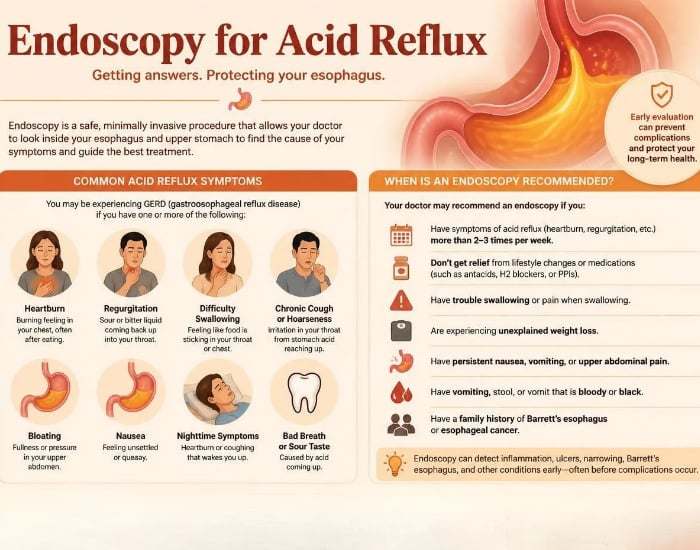
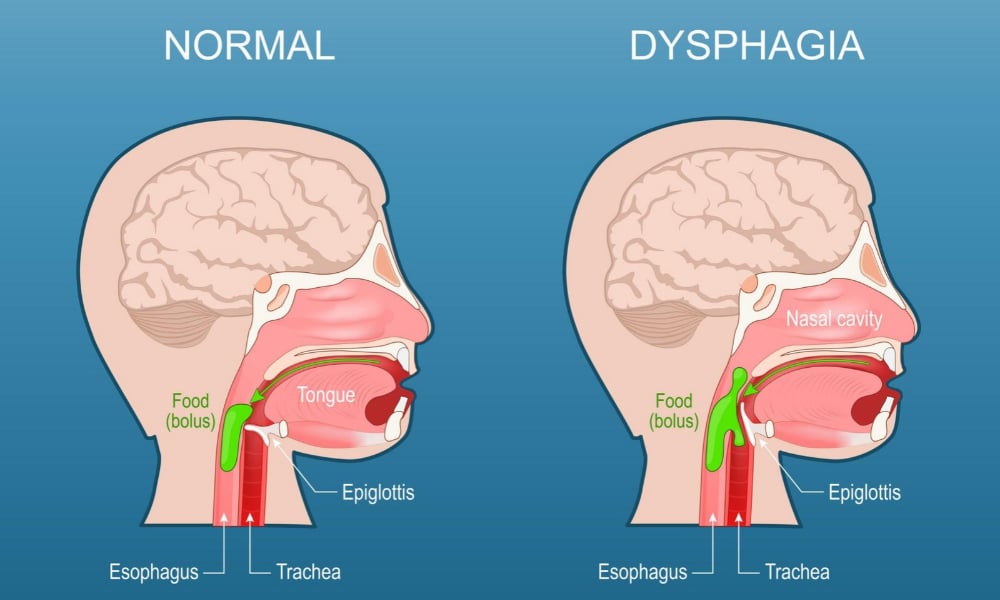
The main symptom is dysphagia, a feeling that food is stuck in the chest or lower throat, especially with solid foods such as meat or bread. Other signs include bringing up undigested food, coughing or choking while eating, chest discomfort, heartburn and weight loss. Symptoms often build slowly, so many people change how they eat before seeking care.
- Solid foods (meat, bread, rice, pills) stick or pass slowly
- Needing to drink liquid to wash food down
- Eating more slowly or avoiding certain foods
- Food coming back up shortly after swallowing
- Pain or pressure behind the breastbone when eating
- Long-standing heartburn or acid reflux
- Unintentional weight loss
Which stricture symptoms need faster evaluation?
- Trouble swallowing that is getting worse over weeks
- Difficulty with liquids as well as solids
- Weight loss, vomiting blood or black stools
- New swallowing problems after age 50
Swallowing problems have many causes beyond strictures, including motility disorders like achalasia. Our guide on food stuck in the throat covers the full range.
What Causes an Esophageal Stricture?
The most common causes are chronic acid reflux, which leads to a peptic stricture, a Schatzki ring at the bottom of the esophagus and eosinophilic esophagitis. Less common causes include radiation, swallowing a caustic substance, pill injury, prior esophageal surgery and esophageal cancer. Finding the cause matters because it decides which treatment keeps the narrowing from returning.
How does GERD cause a peptic stricture?
Years of stomach acid washing into the esophagus cause inflammation that heals with scar tissue. Over time the scar contracts and narrows the lower esophagus. Widespread use of acid-suppressing medicine has made peptic strictures less common, but they remain a leading cause in adults with long-standing reflux.
What is a Schatzki ring?
A thin ring of tissue where the esophagus meets the stomach. It often causes episodes of meat or bread sticking, sometimes called “steakhouse syndrome,” and usually responds well to a single dilation.
How does eosinophilic esophagitis cause a stricture?
An allergic-type inflammation of the esophagus, common in younger adults and in people with asthma, eczema or food allergies. EoE can create rings and a narrow esophagus and is a frequent cause of food impactions. It is confirmed with biopsies.
What other conditions can cause an esophageal stricture?
- Radiation therapy to the chest or neck
- Caustic ingestion (lye, strong cleaners)
- Pill esophagitis from tablets that lodge in the esophagus, such as some antibiotics, NSAIDs, potassium or bisphosphonates
- Narrowing at a surgical join after esophageal surgery
- Long-term nasogastric tube use
- Esophageal cancer or nearby tumors
How Is an Esophageal Stricture Diagnosed?
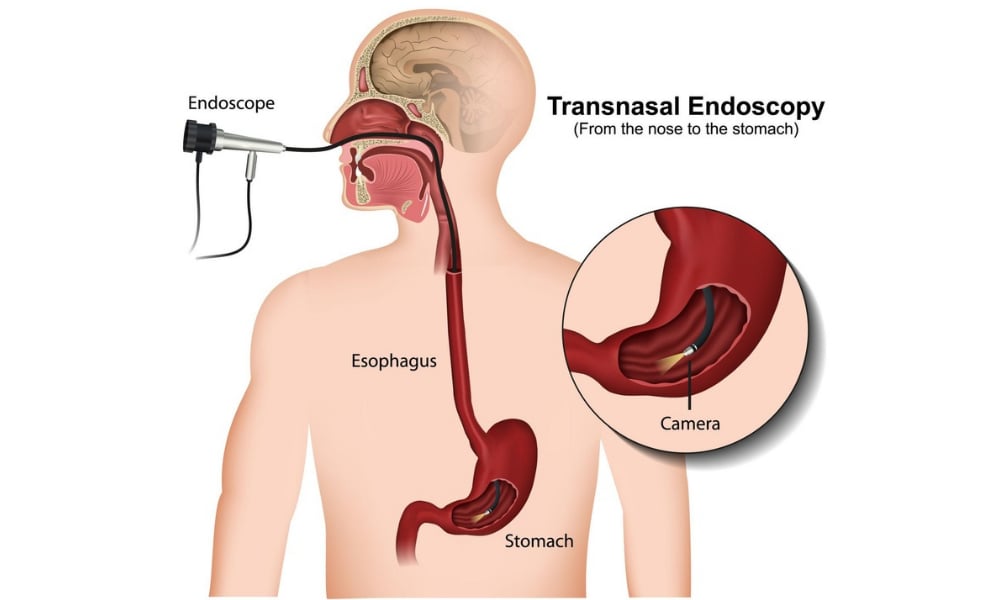
An upper endoscopy, also called an EGD, is the main test. It lets the gastroenterologist see the stricture, take biopsies to check for eosinophilic esophagitis, Barrett's esophagus or cancer, and often stretch the narrowing during the same visit. A barium swallow X-ray may be done first for long or complex strictures to map their length and shape.
- History. Which foods stick, how long it has been happening, reflux symptoms, allergies, medicines and any weight loss.
- Upper endoscopy (EGD). A thin, flexible camera passed through the mouth under sedation. Learn what to expect on our EGD page.
- Biopsies. Small tissue samples from the esophagus, including from normal-looking areas when EoE is suspected.
- Barium esophagram. A swallowed contrast X-ray that maps the length and shape of complex strictures.
- Esophageal manometry if a muscle or motility problem is suspected instead of a fixed narrowing.
Food sticking when you swallow?
Dr. Muhammad Ali Khan, a board-certified gastroenterologist and hepatologist, evaluates swallowing problems and performs endoscopy and esophageal dilation for patients from our Katy and Cypress offices.
How Is an Esophageal Stricture Treated?
Benign strictures are treated with esophageal dilation, which gently stretches the narrow area with a balloon or a tapered dilator during an upper endoscopy. Most patients go home the same day and eat soft foods within hours. Treating the underlying cause, usually reflux or eosinophilic esophagitis, is what keeps the stricture from coming back after dilation.
| Feature | Balloon dilation | Bougie dilation |
|---|---|---|
| How it works | A balloon is inflated inside the narrow area | Tapered tubes of increasing size are passed through it |
| Often used for | Short or very tight strictures | Longer strictures and Schatzki rings |
| Guidance | Direct view through the endoscope | Often passed over a guide wire |
| Recovery | Home the same day | Home the same day |
How esophageal dilation works
- SedationYou are kept comfortable during the procedure.
- EndoscopyThe stricture is examined and biopsied if needed.
- StretchingA balloon or tapered dilator widens the opening step by step.
- RecoveryHome the same day, usually with liquids then soft foods.
What is the difference between balloon and bougie dilation?
Balloon dilators are passed through the endoscope and inflated to a set width. Bougie dilators (such as Savary dilators) are tapered tubes passed over a guidewire. Both are effective; the choice depends on the stricture’s shape and length. Dilation is done gradually to lower the risk of a tear. Learn more on our esophageal dilation page.
Why does treating the underlying cause matter?
- Peptic strictures: long-term acid suppression with a proton pump inhibitor lowers the chance of the stricture returning. Diet and lifestyle steps help too — see foods for GERD.
- EoE: PPIs, swallowed topical steroids, dietary elimination or, in some cases, a biologic medicine.
- Pill injury: take tablets upright with a full glass of water and avoid lying down right after.
What happens when strictures keep coming back?
A small group of strictures are refractory, meaning they keep narrowing despite several dilations. Options then include steroid injection into the stricture, incision of a ring, temporary stents or, rarely, surgery. Most patients still achieve good swallowing with the right plan.
What Are the Risks and Recovery After Esophageal Dilation?
Esophageal dilation is generally safe and is done under sedation. Mild chest discomfort or a sore throat for a day is common, and most people return to normal activity the next day. Serious complications such as a tear, called a perforation, or significant bleeding are uncommon, occurring in well under one percent of simple strictures.
- You will need someone to drive you home because of sedation.
- Most people start with liquids and progress to soft foods the same day, as instructed.
- Call your doctor right away for severe chest or neck pain, fever, trouble breathing or vomiting blood after the procedure.
- If you take blood thinners, your care team will tell you whether and how to pause them.
Can You Prevent an Esophageal Stricture?
The best prevention is controlling acid reflux early, treating eosinophilic esophagitis when it is diagnosed and taking pills properly with a full glass of water while upright. Long-standing heartburn should not be ignored, because healed inflammation is what forms the scar. Eating slowly and chewing well also helps. Regular follow-up helps catch narrowing before swallowing becomes difficult.
Patients in Katy, Cypress and Fulshear with daily heartburn or reflux for years should talk with a gastroenterologist about whether an endoscopy is needed. Our GERD treatment page and our difficulty swallowing specialist page explain how we evaluate both problems.
Frequently Asked Questions About Esophageal Strictures
What does an esophageal stricture feel like?
Most people feel solid food stick in the chest or at the base of the throat, sometimes with pain or the need to bring the food back up. Liquids usually pass more easily until the narrowing becomes severe.
Can an esophageal stricture heal on its own?
A stricture made of scar tissue does not usually go away on its own. Dilation opens the narrowing, and treating reflux or eosinophilic esophagitis helps keep it open.
How many dilations will I need for an esophageal stricture?
Many simple strictures need only one to three dilations to relieve symptoms. Complex or recurring strictures may need repeat sessions spaced a few weeks apart.
Where can I get esophageal stricture treatment in Katy or Cypress, TX?
United Gastroenterology Associates offers upper endoscopy and esophageal dilation for patients in Katy, Cypress and nearby areas. Muhammad Ali Khan, MD, evaluates swallowing problems and builds a plan to treat both the narrowing and its cause.
What sources support this article?
- ASGE — Esophageal dilation guideline
- MedlinePlus — Esophageal stricture, benign
- ACG — Clinical guideline for the diagnosis and management of GERD (2022)
- Gastroenterology & Hepatology — Management of refractory benign esophageal strictures
Where can you see a gastroenterologist in Katy or Cypress?
United Gastroenterology Associates has two offices: Katy, at 23920 Katy Freeway, Suite 555, next to Memorial Hermann Katy Hospital, and Cypress, at 21216 Northwest Freeway, Suite 640, on US-290. Both are open Monday through Friday, 8:30 AM to 5:00 PM, closed for lunch from 12:00 to 1:30 PM, and serve patients from Fulshear, Richmond and across Greater Houston. Call (346) 340-4414 for either office.
Where is the Katy office?
23920 Katy Freeway, Suite 555
Katy, TX 77494
Memorial Hermann Medical Plaza 1
Where is the Cypress office?
21216 Northwest Freeway, Suite 640
Cypress, TX 77429
On US-290
What should you do next?
If food sticks when you swallow, or swallowing has become slower or more careful over time, an upper endoscopy can find the cause and often treat a stricture in the same visit. Dr. Muhammad Ali Khan and the team at United Gastroenterology Associates see adults from Katy, Cypress, Fulshear, Richmond and across Greater Houston. Call (346) 340-4414 or request an appointment today.