How often should you get a colonoscopy?
As Dr. Khan explains, adults at average risk should start colonoscopy screening at age 45 and repeat it every 10 years if the result is normal. People with a parent, sibling or child who had colon cancer or advanced polyps usually start at 40, or 10 years before that relative's diagnosis, and repeat every 5 years. If polyps are found, the next colonoscopy may be in 3, 5, 7 or 10 years depending on their number, size and type.
Colonoscopy screening intervals at a glance
- Average risk, normal resultEvery 10 years from age 45.
- Family historyStart at 40 or earlier; usually every 5 years.
- Polyps or IBD1 to 7 years, set by your gastroenterologist.
What does a colonoscopy detect?
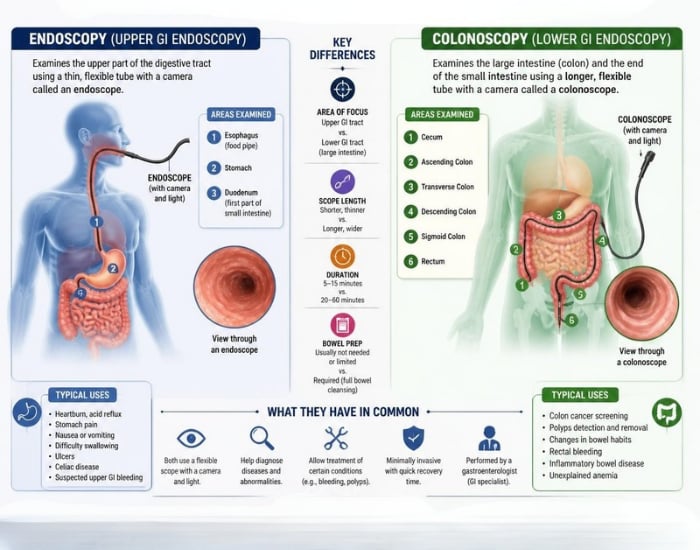
A colonoscopy detects colon and rectal polyps, colorectal cancer, inflammation from ulcerative colitis, Crohn's disease or microscopic colitis, diverticulosis, hemorrhoids and sources of bleeding. Most polyps are removed during the exam and sent for testing. Biopsies of any unusual area help confirm a diagnosis, so colonoscopy both screens for and helps diagnose many colon conditions.
| Finding at last colonoscopy | Typical next colonoscopy |
|---|---|
| Normal, average risk | 10 years |
| 1 to 2 small tubular adenomas (under 10 mm) | 7 to 10 years |
| 3 to 4 small adenomas | 3 to 5 years |
| Adenoma 10 mm or larger, or advanced features | 3 years |
| Large polyp removed in pieces | 6 months |
| Small hyperplastic polyps in the rectum | 10 years |
| Ulcerative colitis or Crohn's colitis (8+ years) | Every 1 to 3 years |
When should you stop colonoscopy screening?
Screening is recommended through age 75 for most people. Between ages 76 and 85, the decision is individual and depends on overall health, life expectancy and prior results. Screening is generally not recommended after age 85. Your gastroenterologist will weigh the benefits and risks with you, especially if you have never been screened before.
Do not wait for your screening date if you have
- Rectal bleeding or blood in the stool
- A change in bowel habits lasting more than three weeks
- Iron deficiency anemia
- Unexplained weight loss
- A positive stool test such as FIT or Cologuard
Have symptoms like these?
Dr. Muhammad Ali Khan, a board-certified gastroenterologist and hepatologist, sees adults at our Katy and Cypress offices, serving patients across Greater Houston.
Are there alternatives to colonoscopy?
Yes, stool-based tests such as a yearly FIT and stool DNA testing every three years, and CT colonography every five years, are accepted screening options for average-risk adults. Any abnormal result needs a follow-up colonoscopy. These tests do not remove polyps, so people at higher risk or with symptoms are usually advised to have a colonoscopy.
Tip: Keep a copy of your colonoscopy and pathology report. The polyp type and size decide your next interval, and having the report avoids repeating screening too early or too late.
How do you prepare for a colonoscopy?
Preparation involves a low-residue diet for a day or two, clear liquids the day before and a bowel prep solution taken in split doses. A clean colon lets the doctor see small polyps that might otherwise be missed. Arrange a ride home after sedation, and ask the office how to adjust blood thinners or diabetes medicines.
Where can you get a screening colonoscopy near Katy or Cypress?
Dr. Muhammad Ali Khan performs screening and diagnostic colonoscopies for patients from Katy, Cypress, Fulshear, Richmond and greater Houston. Learn more about how to prepare for a colonoscopy and what a colonoscopy detects before your visit. Call United Gastroenterology Associates or request an appointment online to schedule your screening at either office.
Get answers instead of guessing
Request a visit with Dr. Muhammad Ali Khan at our Katy and Cypress offices. Call the office to check your insurance coverage; self-pay options are available.
What are the key takeaways?
- Average-risk adults start colonoscopy screening at 45 and repeat every 10 years if normal.
- Family history usually means starting at 40 and repeating every 5 years.
- The type, size and number of polyps set your next interval.
- Colonoscopy detects polyps, cancer, colitis, diverticulosis and bleeding sources.
- Symptoms or a positive stool test need a colonoscopy right away.
Frequently Asked Questions
Is colonoscopy covered by insurance?
Most private plans and Medicare cover screening colonoscopy for average-risk adults starting at age 45. Diagnostic colonoscopies are also covered, but deductibles or coinsurance may apply.
Does colonoscopy hurt?
Most people feel little or nothing during a colonoscopy because sedation is used. Mild bloating or cramping afterward usually fades within a few hours.
How long does a colonoscopy take?
The procedure itself usually takes about twenty to sixty minutes. Plan on two to three hours at the facility, including check-in and recovery.
Do I need a referral to see a gastroenterologist in Katy or Cypress?
Many PPO plans and traditional Medicare do not require a referral, while HMO plans usually do. United Gastroenterology Associates can check your plan before you schedule.
What sources support this article?
- NIDDK — Colonoscopy
- MedlinePlus — Colonoscopy
- USPSTF — Colorectal cancer screening
- American College of Gastroenterology — Colorectal cancer
- National Cancer Institute — Colorectal cancer
Where can you see a gastroenterologist in Katy or Cypress?
United Gastroenterology Associates has two offices: Katy, at 23920 Katy Freeway, Suite 555, next to Memorial Hermann Katy Hospital, and Cypress, at 21216 Northwest Freeway, Suite 640, on US-290. Both are open Monday through Friday, 8:30 AM to 5:00 PM, closed for lunch from 12:00 to 1:30 PM, and serve patients from Fulshear, Richmond and across Greater Houston. Call (346) 340-4414 for either office.
Where is the Katy office?
23920 Katy Freeway, Suite 555
Katy, TX 77494
Memorial Hermann Medical Plaza 1
Where is the Cypress office?
21216 Northwest Freeway, Suite 640
Cypress, TX 77429
On US-290
What should you do next?
If you are dealing with how often should you get a colonoscopy or any ongoing digestive concern, a focused evaluation can find the cause and start the right treatment. Dr. Muhammad Ali Khan and the team at United Gastroenterology Associates see adults from Katy, Cypress, Fulshear, Richmond, Greater Houston and across Texas. Call (346) 340-4414 or request an appointment today.
If you have severe pain, vomit blood, pass black stools or have chest pain, call 911 or go to the nearest emergency room.