How is colorectal cancer diagnosed?
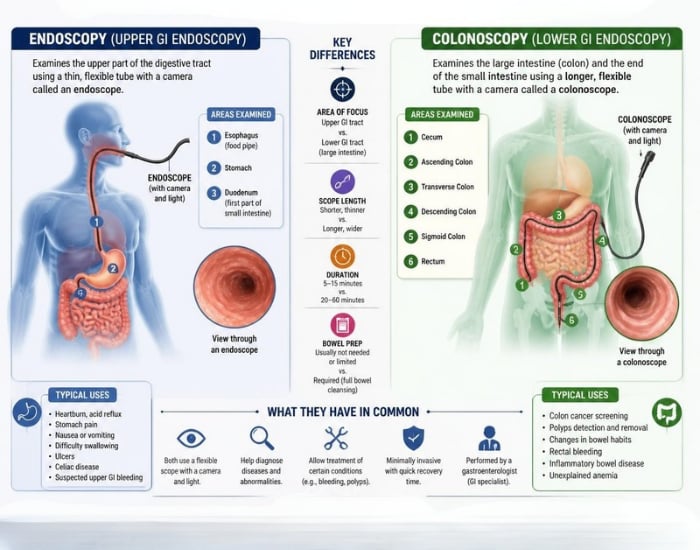
Colorectal cancer is diagnosed with a colonoscopy, during which a gastroenterologist such as Dr. Khan examines the whole colon and rectum and takes biopsies of any suspicious area. A pathologist confirms cancer under the microscope. If cancer is found, CT scans, blood tests including CEA and, for rectal cancer, MRI are used to stage it.
Stool tests and blood in the stool can point to the need for colonoscopy but cannot diagnose cancer on their own.
How colorectal cancer is diagnosed, step by step
- Symptoms or screeningWarning signs, a positive stool test or routine screening at 45.
- Colonoscopy and biopsyDirect view of the colon, polyp removal and tissue sampling.
- PathologyThe biopsy confirms cancer and its type.
- StagingCT, MRI and CEA blood test show whether it has spread.
What are the warning signs of colorectal cancer?
Warning signs that should prompt a visit with Dr. Khan include blood in or on the stool, a change in bowel habits lasting more than a few weeks, narrower stools, a feeling that the bowel does not empty, abdominal pain or cramping, unexplained weight loss, fatigue and iron deficiency anemia. Early colorectal cancer often causes no symptoms, which is why screening is so important. See colon cancer warning signs.
Do not ignore these signs
- Rectal bleeding or dark, maroon stools
- Bowel changes lasting more than three weeks
- Iron deficiency anemia without a clear cause
- Unexplained weight loss
- Symptoms at any age, including under 50
What tests are used to diagnose and stage colorectal cancer?
Each test answers a different question. Stool tests and screening find who needs a colonoscopy, and colonoscopy with biopsy confirms the diagnosis. CT scans of the chest, abdomen and pelvis check for spread, MRI or endoscopic ultrasound stages rectal cancer, and a CEA blood test gives a baseline. Together, these results set the stage and the treatment plan.
| Test | Purpose | Notes |
|---|---|---|
| FIT or stool DNA test | Screening | A positive result needs a colonoscopy |
| Colonoscopy with biopsy | Diagnosis | Can remove polyps during the same procedure |
| CT of chest, abdomen and pelvis | Staging | Looks for spread to lymph nodes, liver or lungs |
| Pelvic MRI or rectal ultrasound | Rectal cancer staging | Shows depth and nearby lymph nodes |
| CEA blood test | Baseline and follow-up | Tracks response and recurrence |
| Biomarker testing | Treatment planning | Checks MSI, KRAS and other markers |
Have symptoms like these?
Dr. Muhammad Ali Khan, a board-certified gastroenterologist and hepatologist, sees adults at our Katy and Cypress offices, serving patients across Greater Houston.
What are the stages of colorectal cancer?
Stage 0 is limited to the inner lining. Stage I has grown into the bowel wall. Stage II has grown through the wall but not to lymph nodes. Stage III has spread to nearby lymph nodes. Stage IV has spread to distant organs such as the liver or lungs. The earlier the stage, the higher the chance of cure, with five-year survival around 90 percent for localized disease.
How is colorectal cancer treated?
Treatment depends on the stage and location. Very early cancers in a polyp may be removed completely during colonoscopy. Most other cases need surgery to remove the affected part of the colon or rectum and nearby lymph nodes. Chemotherapy, radiation (mainly for rectal cancer), targeted therapy and immunotherapy are added depending on stage and biomarkers. Care is coordinated between your gastroenterologist, surgeon and oncologist.
Tip: If a parent, sibling or child had colorectal cancer or advanced polyps, ask about starting screening at 40, or 10 years before their age at diagnosis, whichever is earlier.
When should you get a colonoscopy?
Average-risk adults should start colorectal cancer screening at 45. Anyone with warning signs, a positive stool test, a strong family history or IBD should talk to a gastroenterologist sooner. Dr. Muhammad Ali Khan performs diagnostic and screening colonoscopies for patients from Katy, Cypress, Fulshear, Richmond and Greater Houston. Learn about colon cancer screening, what to do after a positive Cologuard and GI cancer care.
Get answers instead of guessing
Request a visit with Dr. Muhammad Ali Khan at our Katy and Cypress offices. Call the office to check your insurance coverage; self-pay options are available.
What are the key takeaways?
- Colonoscopy with biopsy is how colorectal cancer is diagnosed.
- Stool tests screen but do not diagnose; a positive test needs a colonoscopy.
- CT, MRI and CEA blood tests determine the stage.
- Early-stage colorectal cancer has a high cure rate.
- Screening starts at 45 for average-risk adults, earlier with family history.
Frequently Asked Questions
Can a blood test detect colorectal cancer?
Some blood-based screening tests are available, but they are less sensitive than colonoscopy, especially for precancerous polyps. The CEA blood test is used mainly to monitor known cancer, not to diagnose it.
How long do biopsy results take?
Biopsy results from a colonoscopy usually take a few days to about a week. Your doctor will contact you to explain the results and next steps.
Can colorectal cancer happen under 50?
Yes, colorectal cancer rates have been rising in adults under 50. Symptoms such as rectal bleeding or bowel changes deserve evaluation at any age.
Do I need a referral to see a gastroenterologist in Katy or Cypress?
Many PPO plans and traditional Medicare do not require a referral, while HMO plans usually do. United Gastroenterology Associates can check your plan before you schedule.
What sources support this article?
- MedlinePlus — Colorectal cancer
- National Cancer Institute — Colorectal cancer
- USPSTF — Colorectal cancer screening
- American College of Gastroenterology — Colorectal cancer
- NIDDK — Colonoscopy
Where can you see a gastroenterologist in Katy or Cypress?
United Gastroenterology Associates has two offices: Katy, at 23920 Katy Freeway, Suite 555, next to Memorial Hermann Katy Hospital, and Cypress, at 21216 Northwest Freeway, Suite 640, on US-290. Both are open Monday through Friday, 8:30 AM to 5:00 PM, closed for lunch from 12:00 to 1:30 PM, and serve patients from Fulshear, Richmond and across Greater Houston. Call (346) 340-4414 for either office.
Where is the Katy office?
23920 Katy Freeway, Suite 555
Katy, TX 77494
Memorial Hermann Medical Plaza 1
Where is the Cypress office?
21216 Northwest Freeway, Suite 640
Cypress, TX 77429
On US-290
What should you do next?
If you are dealing with how colorectal cancer is diagnosed or any ongoing digestive concern, a focused evaluation can find the cause and start the right treatment. Dr. Muhammad Ali Khan and the team at United Gastroenterology Associates see adults from Katy, Cypress, Fulshear, Richmond, Greater Houston and across Texas. Call (346) 340-4414 or request an appointment today.
If you have severe pain, vomit blood, pass black stools or have chest pain, call 911 or go to the nearest emergency room.