Can GERD cause a chronic cough?
Yes. Dr. Khan notes that GERD is one of the three most common causes of chronic cough in adults, along with asthma and postnasal drip. Reflux can cause coughing when acid in the lower esophagus triggers a nerve reflex, and when small amounts of refluxed fluid reach the throat or airways and irritate them. Many people with reflux-related cough have little or no heartburn.
A chronic cough is one that lasts eight weeks or longer in adults. Because many conditions cause cough, doctors usually check the lungs, sinuses and medicines as well as reflux.
How reflux triggers a cough
- Nerve reflexAcid in the lower esophagus stimulates nerves that trigger the cough reflex.
- Throat irritationReflux reaching the voice box causes throat clearing, hoarseness and coughing.
- Cough-reflux cycleHard coughing raises belly pressure, which can push more reflux upward.
What are the signs that a cough is caused by reflux?
A cough is more likely to be reflux-related if it is dry and long-lasting, worse after meals, when lying down or at night, and comes with throat clearing, hoarseness, a sour taste, regurgitation, a feeling of a lump in the throat or heartburn. Normal chest X-rays and a cough that has not improved with asthma or allergy treatment also raise suspicion for reflux.
| Cause | Typical clues |
|---|---|
| GERD or silent reflux | Worse after meals or lying down, throat clearing, sour taste |
| Asthma | Wheezing, chest tightness, cough with exercise or cold air |
| Postnasal drip | Runny nose, sinus congestion, dripping feeling in the throat |
| ACE inhibitor medicines | Dry cough after starting certain blood pressure pills |
| Lung infection or disease | Fever, colored mucus, shortness of breath, weight loss |
When is a chronic cough a warning sign?
See a doctor promptly for a cough with coughing up blood, shortness of breath, chest pain, fever, night sweats, unexplained weight loss, trouble swallowing or hoarseness lasting more than three weeks. A cough in someone who smokes or has smoked also needs evaluation. These warning signs can point to infection, lung disease or cancer rather than reflux.
Get prompt care for
- Coughing up blood
- Shortness of breath, wheezing that worsens, or chest pain
- Fever, night sweats or unexplained weight loss
- Trouble swallowing or food sticking
- A long history of smoking with a new or changing cough
Have symptoms like these?
Dr. Muhammad Ali Khan, a board-certified gastroenterologist and hepatologist, sees adults at our Katy and Cypress offices, serving patients across Greater Houston.
How is reflux-related cough diagnosed?
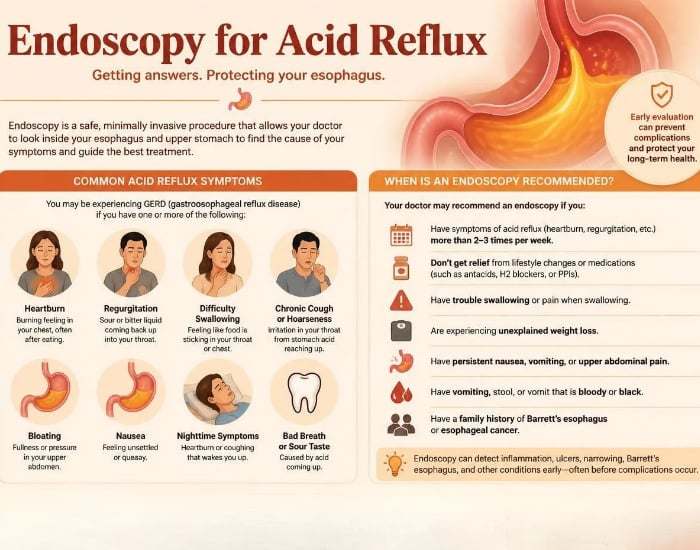
Doctors often start by checking for other common causes, such as asthma, postnasal drip and medicines, and may try a course of reflux treatment. When the cough persists, a gastroenterologist can use upper endoscopy to look at the esophagus and esophageal pH or pH-impedance monitoring to measure reflux and see whether cough episodes line up with reflux events. An ear, nose and throat specialist may examine the voice box.
How is a GERD cough treated?
A GERD-related cough is treated by controlling reflux: raising the head of the bed, avoiding meals two to three hours before lying down, eating smaller meals, losing weight if needed, stopping smoking, and limiting alcohol and trigger foods, often with acid-reducing medicine. Cough can take eight weeks or more to improve because irritated tissue heals slowly. If cough persists, testing helps decide the next step.
- Raise the head of the bed 6 to 8 inches
- Finish dinner two to three hours before bed
- Limit alcohol, fatty foods, chocolate, mint and late caffeine
- Stop smoking and avoid secondhand smoke
- Sip water rather than clearing your throat repeatedly
Tip: Give treatment time
Reflux cough often improves slowly. Keep a simple weekly cough score from 0 to 10 so you and your doctor can see whether treatment is helping over two months.
When should I see a gastroenterologist for chronic cough?
See a gastroenterologist if a cough lasts more than eight weeks along with heartburn, regurgitation, throat clearing or hoarseness, if lung and allergy causes have been checked, or if reflux treatment has not helped after several weeks. Dr. Khan can coordinate testing with your primary care, lung or ENT doctor.
Read more about reflux and breathing symptoms and GERD care.
Get answers instead of guessing
Request a visit with Dr. Muhammad Ali Khan at our Katy and Cypress offices. Call the office to check your insurance coverage; self-pay options are available.
What are the key takeaways?
- GERD is a common cause of chronic cough in adults, often without heartburn.
- Reflux cough is often dry, worse after meals or lying down, with throat clearing or hoarseness.
- Coughing up blood, fever, weight loss or shortness of breath needs prompt evaluation.
- Endoscopy and pH monitoring can confirm reflux when cough persists.
- Reflux treatment may take eight weeks or more to improve a cough.
Frequently Asked Questions
What does a GERD cough sound like?
A GERD cough is usually dry and persistent, sometimes with throat clearing or hoarseness. It often gets worse after meals, when lying down or when speaking for a long time.
Can acid reflux cause a cough without heartburn?
Yes, many people with reflux-related cough never feel heartburn. This form is sometimes called silent reflux or laryngopharyngeal reflux.
How long does it take for a GERD cough to go away?
A GERD cough often improves within eight to twelve weeks of consistent reflux treatment. If it does not improve, your doctor may order tests such as pH monitoring.
Do I need a referral to see a gastroenterologist in Katy or Cypress?
Many PPO plans and traditional Medicare do not require a referral, while HMO plans usually do. United Gastroenterology Associates can check your plan before you schedule.
What sources support this article?
- NIDDK — Symptoms and causes of GER and GERD
- NIDDK — Treatment for GER and GERD
- MedlinePlus — Cough
- MedlinePlus — GERD
- American College of Gastroenterology — Acid reflux
Where can you see a gastroenterologist in Katy or Cypress?
United Gastroenterology Associates has two offices: Katy, at 23920 Katy Freeway, Suite 555, next to Memorial Hermann Katy Hospital, and Cypress, at 21216 Northwest Freeway, Suite 640, on US-290. Both are open Monday through Friday, 8:30 AM to 5:00 PM, closed for lunch from 12:00 to 1:30 PM, and serve patients from Fulshear, Richmond and across Greater Houston. Call (346) 340-4414 for either office.
Where is the Katy office?
23920 Katy Freeway, Suite 555
Katy, TX 77494
Memorial Hermann Medical Plaza 1
Where is the Cypress office?
21216 Northwest Freeway, Suite 640
Cypress, TX 77429
On US-290
What should you do next?
If you are dealing with chronic cough gerd or any ongoing digestive concern, a focused evaluation can find the cause and start the right treatment. Dr. Muhammad Ali Khan and the team at United Gastroenterology Associates see adults from Katy, Cypress, Fulshear, Richmond, Greater Houston and across Texas. Call (346) 340-4414 or request an appointment today.
If you have severe pain, vomit blood, pass black stools or have chest pain, call 911 or go to the nearest emergency room.