Is acid reflux dangerous?
Occasional acid reflux is not dangerous. Frequent, long-standing reflux (GERD) can become harmful if untreated, because acid can inflame the esophagus (esophagitis), cause ulcers or bleeding, scar and narrow it (a stricture), and in some people change the lining into Barrett’s esophagus, which slightly raises the risk of esophageal cancer. Reflux can also irritate the throat and lungs. Most of these problems can be prevented or managed with treatment and, when needed, monitoring.
How untreated reflux can progress
- Frequent refluxAcid repeatedly reaches the esophagus, often causing heartburn and regurgitation.
- EsophagitisThe lining becomes inflamed and can develop erosions or ulcers.
- ComplicationsBleeding, scarring and narrowing, or Barrett’s esophagus in some people.
- PreventionTreatment heals inflammation; surveillance finds changes early.
What are the complications of acid reflux?
The main complications of long-term acid reflux are erosive esophagitis, esophageal ulcers and bleeding, esophageal strictures that make swallowing difficult, Barrett’s esophagus, and rarely esophageal adenocarcinoma. Reflux can also cause chronic cough, hoarseness, worsening asthma, dental erosion and, uncommonly, aspiration of stomach contents into the lungs.
| Complication | What happens | Possible clues |
|---|---|---|
| Esophagitis | Inflamed, eroded lining | Painful swallowing, persistent heartburn |
| Ulcers and bleeding | Open sores in the esophagus | Black stools, vomiting blood, anemia |
| Stricture | Scar tissue narrows the esophagus | Food sticking, trouble swallowing solids |
| Barrett’s esophagus | Lining changes to a different cell type | Often no extra symptoms; found on endoscopy |
| Throat and lung effects | Reflux reaches the throat or airways | Chronic cough, hoarseness, asthma flares |
What is Barrett’s esophagus?
Barrett’s esophagus is a condition in which the normal lining of the lower esophagus is replaced by tissue similar to the intestinal lining, usually after years of acid reflux. It does not cause symptoms by itself and is found during upper endoscopy with biopsies. Barrett’s esophagus raises the risk of esophageal adenocarcinoma, but the overall risk remains low, and regular surveillance can find precancerous changes early when they can be treated.
Have symptoms like these?
Dr. Muhammad Ali Khan, a board-certified gastroenterologist and hepatologist, sees adults at our Katy and Cypress offices, serving patients across Greater Houston.
Who is at higher risk of acid reflux complications?
The risk of complications is higher in people who have had frequent heartburn for five years or more, especially men over 50, people who are white, have extra abdominal weight, smoke or have smoked, have a hiatal hernia, have night-time reflux, or have a family history of Barrett’s esophagus or esophageal cancer. People with several of these risk factors may benefit from a screening endoscopy.
What are the warning signs that reflux is dangerous?
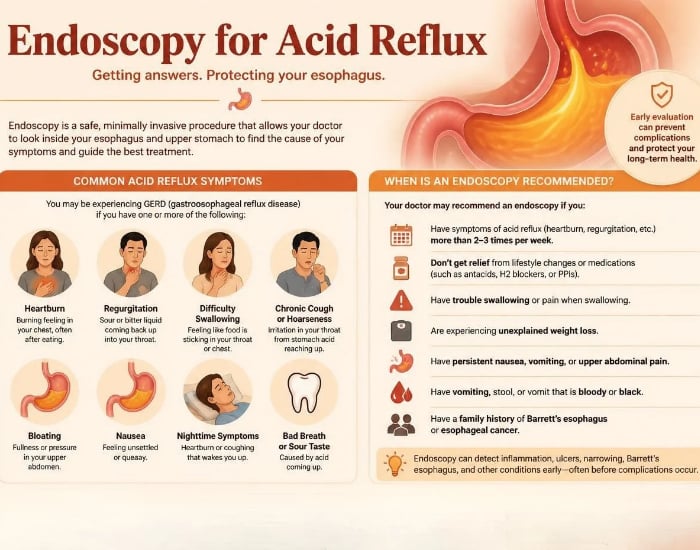
Warning signs that reflux may be causing harm include trouble swallowing or food sticking, pain when swallowing, unexplained weight loss, vomiting, vomiting blood or material like coffee grounds, black stools, iron-deficiency anemia, and heartburn that continues despite treatment. New reflux after age 60 also deserves evaluation. Chest pain should always be checked for heart causes first.
Get prompt care for
- Difficulty or pain when swallowing, or food getting stuck
- Unexplained weight loss or iron-deficiency anemia
- Vomiting blood, coffee-ground vomit or black stools
- Persistent heartburn despite medicine
- Chest pain or pressure (call 911)
How do doctors check for reflux damage?
Doctors check for reflux damage with an upper endoscopy (EGD), which lets the gastroenterologist see inflammation, ulcers, strictures and Barrett’s esophagus and take biopsies. Esophageal pH monitoring measures acid exposure when the diagnosis is unclear, and a barium swallow may be used for swallowing problems. Dr. Khan performs or arranges these tests and can dilate a narrowed esophagus when needed.
Learn more about upper endoscopy (EGD) and GERD care.
Get answers instead of guessing
Request a visit with Dr. Muhammad Ali Khan at our Katy and Cypress offices. Most major insurance plans are accepted and self-pay options are available.
How can I lower my risk?
You can lower the risk of reflux complications by treating frequent heartburn rather than ignoring it, taking acid-reducing medicine as prescribed, losing extra weight, stopping smoking, limiting alcohol, avoiding late meals, raising the head of the bed and keeping up with recommended endoscopy if you have Barrett’s esophagus or several risk factors.
Tip: Count your years of heartburn
If you have had heartburn most weeks for five years or more, mention it at your next visit. Long duration, not just severity, is one of the factors doctors use to decide on screening.
Key takeaways
- Occasional acid reflux is not dangerous, but frequent untreated GERD can damage the esophagus.
- Complications include esophagitis, ulcers, strictures and Barrett’s esophagus.
- Barrett’s esophagus slightly raises cancer risk, and surveillance finds changes early.
- Trouble swallowing, weight loss, bleeding or anemia are warning signs that need prompt care.
- Treatment and healthy habits prevent most complications.
Frequently asked questions
Can acid reflux cause cancer?
Long-standing reflux can lead to Barrett’s esophagus, which raises the risk of esophageal adenocarcinoma. The overall risk is low, and treatment plus monitoring lower it further.
Is it dangerous to ignore acid reflux?
Ignoring frequent reflux for years can allow inflammation and complications to develop. Treating it is the best protection.
Can acid reflux damage your teeth?
Yes. Acid reaching the mouth can wear down tooth enamel. Dentists sometimes notice reflux before patients do.
Is acid reflux dangerous in pregnancy?
Reflux is very common in pregnancy and usually improves after delivery. Ask your obstetrician which treatments are safe.
Do I need a referral to see a gastroenterologist in Katy or Cypress?
It depends on your insurance plan. Many PPO plans let you book a specialist directly, while some HMO plans require a referral from your primary care doctor. Call (346) 340-4414 and the team can help you check.
Sources
- NIDDK — Acid reflux (GER and GERD) in adults
- NIDDK — Symptoms and causes of GER and GERD
- NIDDK — Treatment for GER and GERD
- MedlinePlus — GERD
- American College of Gastroenterology — Acid reflux
Where to be seen in Katy and Cypress
United Gastroenterology Associates has two offices: Katy, at 23920 Katy Freeway, Suite 555, next to Memorial Hermann Katy Hospital, and Cypress, at 21216 Northwest Freeway, Suite 640, on US-290. Both are open Monday through Friday, 8:30 AM to 5:00 PM, closed for lunch from 12:00 to 1:30 PM, and serve patients from Fulshear, Richmond and across Greater Houston. Call (346) 340-4414 for either office.
Katy office
23920 Katy Freeway, Suite 555
Katy, TX 77494
Memorial Hermann Medical Plaza 1
Next steps
If you are dealing with is acid reflux dangerous or any ongoing digestive concern, a focused evaluation can find the cause and start the right treatment. Dr. Muhammad Ali Khan and the team at United Gastroenterology Associates see adults from Katy, Cypress, Fulshear, Richmond, Greater Houston and across Texas. Call (346) 340-4414 or request an appointment today.
If you have severe pain, vomit blood, pass black stools or have chest pain, call 911 or go to the nearest emergency room.